Where Research Meets Real-world Business: The Inside Story of How We Successfully Deployed the Bandit Algorithm
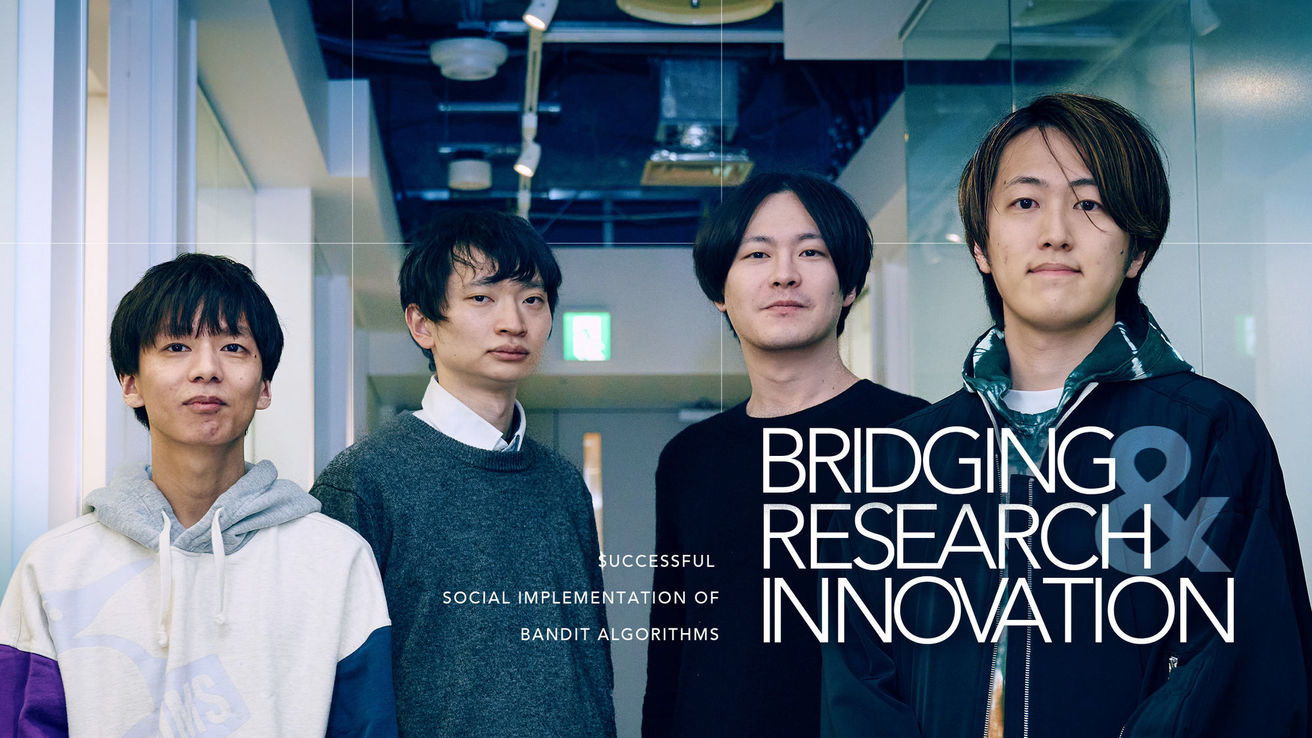
A new technological innovation is emerging in the world of online advertising. Prism Partner, a joint venture between CyberAgent and DOCOMO, has implemented a feature to optimize ad creative selection using the bandit algorithm, a machine learning method. This groundbreaking initiative led to the acceptance of our paper at WSDM 2025, one of the world's top international conferences in the web field. We spoke with the core members of this project to discuss the fusion of research and business, as well as the organizational structure and culture that enabled this value creation.
Contents
World-Class Research Born from the Pursuit of Business Value
The Untapped Potential of Bandit Algorithms in Business
An Ideal Collaboration Between AI Lab and Business Divisions Focused on Business Value
World-Class Research Born from the Pursuit of Business Value
――Congratulations on your paper being accepted at the WSDM 2025! Could you please give us an overview of this research?
Katsuragawa (PP): Thank you. Our research focused on applying a specific bandit algorithm, Top-Two Thompson Sampling (TTTS), to the problem of creative selection in online ads. In advertising, identifying the best creative, for instance, the one with the highest expected Click-Through Rate (CTR), is critical for maximizing an ad's effectiveness. We implemented TTTS in the Prism Partner DSP as a more efficient alternative to traditional A/B testing. This allows us to more accurately identify the best creative while reducing the costs of experimentation.
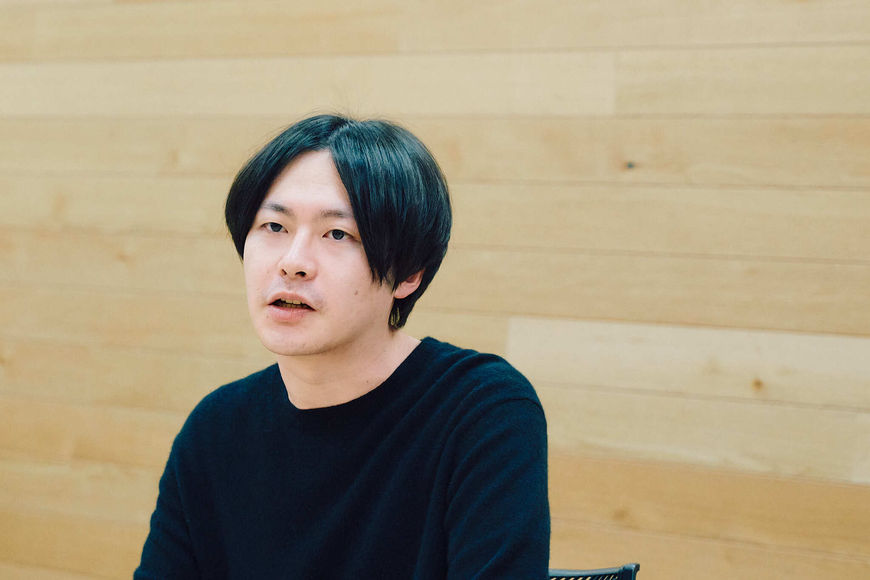
Ariu (AI Lab): The real-world application of TTTS is a leading example. As of our research on April 14, 2025, we found no other papers or presentations that evaluated CTR improvements while the method was fully applied in a live service. We believe these aspects of practical industrial application were highly regarded by the international conference, contributing to our innovation.
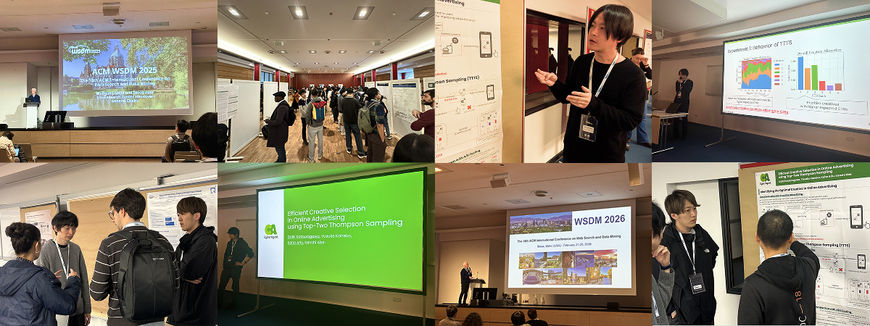
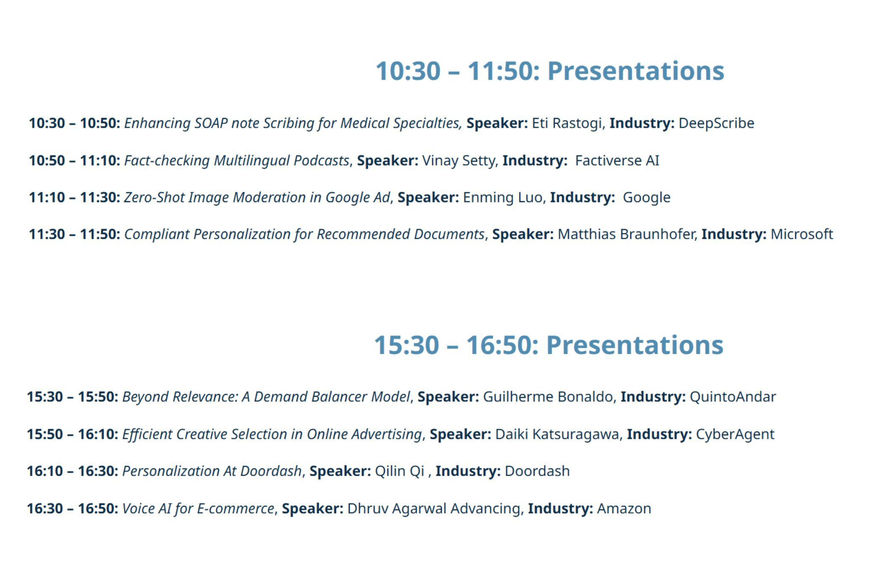
Kaneko (PP): At the recent conference in Germany, we had the honor of presenting on the same stage as the mega-tech companies, like Amazon, Google, and Microsoft.
Katsuragawa (PP): The response to our presentation was greater than we expected, with many specific questions and discussions about its industrial application. It was a valuable experience to be able to discuss the practical ingenuities we employed on-site.
——How did this project begin?
Kaneko (PP): The project originated from a request from the business head of Prism Partner for "feature improvements centered on ad creatives." While exploring various methods to solve this challenge, we focused on "identifying effective creatives as quickly as possible after they go live." Since conventional A/B testing is time-consuming, costly, and complex to manage, we considered leveraging the "bandit algorithm," a method we already had knowledge of.
Katsuragawa (PP): While exploring solutions, I reached out to Ariu and Abe at AI Lab, who focus on bandit algorithm research. We concluded that TTTS was the best approach. Obtaining their deep insights so early in the project was a game-changer for our development speed and problem-solving capabilities. It really hit home how powerful it is to have a research organization right here with us—it gives us such a wide range of technical tools to tackle our challenges.
The Untapped Potential of Bandit Algorithms in Business
——To begin with, in what specific areas and for what challenges can the bandit algorithm be applied?
Ariu (AI Lab): I believe it can be used in almost any service that involves decision-making. Take advertising, our current use case: the algorithm is used to select the right ad creative by observing user reactions. You could imagine a similar application on ABEMA, choosing the best thumbnail or layout based on viewing history. Essentially, any scenario that requires sequential choice—making decisions based on past data—is a potential fit.
Abe (AI Lab): In the AI Division, we have already mastered the large-scale production of creatives with AI tools like our "KIWAMI-Prediction" series. The next challenge is figuring out 'how to effectively select and use' all those creatives. The bandit algorithm holds immense promise for solving this very problem. Our Reinforcement Learning (RL) team at AI Lab has been researching this area for some time, with numerous papers and real-world applications under our belt.
*What is the bandit algorithm? It is a method that learns to make optimal decisions while gathering data on its own. In online advertising, applications include identifying high-performing creatives.
——So, for the new feature in the Prism Partner DSP, you decided the bandit algorithm was a better fit than standard A/B testing.
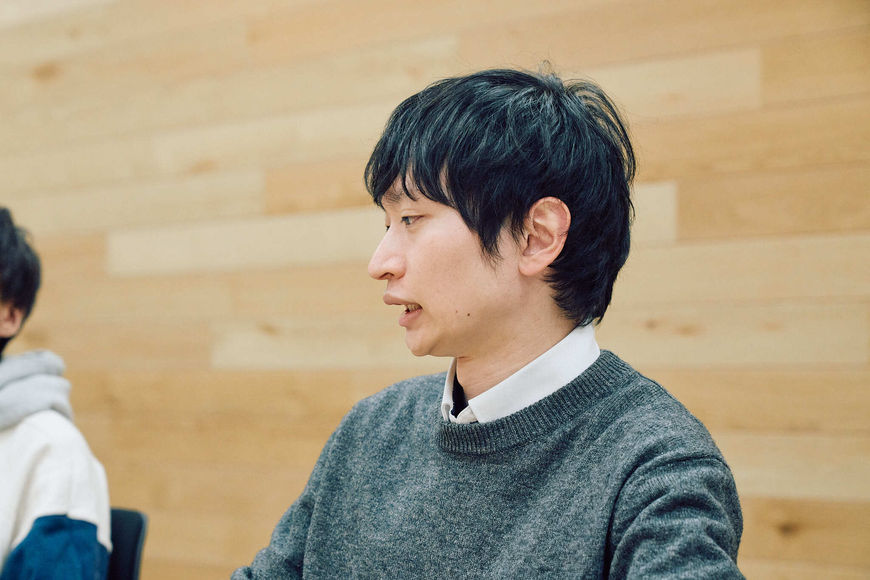
Kaneko (PP): While A/B testing is a standard method for finding the optimal choice, it has the drawbacks of being time-consuming and costly. The bandit algorithm, on the other hand, finds the optimal choice through trial and error, enabling efficient optimization.
Katsuragawa (PP): By using a feature built on the TTTS* method, we've eliminated the manual work of identifying the best creative. It allows for more accurate identification, reduces experimental costs, and contributes to ad effectiveness by efficiently finding the creative with the highest expected CTR. This function is now active on all campaigns running on the Prism Partner DSP.
Ariu (AI Lab): When Katsuragawa shared the results from the Prism Partner DSP implementation, I immediately felt this was strong enough to be presented at an international conference. The four of us discussed which venue would be the best fit, and that's what led to the paper submission for the Industry Day track at WSDM 2025.
*Top-two Thompson sampling (TTTS) is a reinforcement learning method that uses a probabilistic approach to efficiently find the optimal choice. It is particularly useful in scenarios requiring effective selection with a limited number of trials, such as creative optimization in ad delivery.
An Ideal Collaboration Between AI Lab and Business Divisions Focused on Business Value
――It sounds like the close collaboration between the business division and AI Lab was key to this success. Was there anything you consciously focused on to make that partnership work?
Abe (AI Lab): From the AI Lab side, a key principle was 'don't just push the latest methods.' As a researcher, it's tempting to use the latest technique for the sake of a paper, but we always start with the question: 'What's the best method for the product?' We run alongside the business teams with that mindset.
Ariu (AI Lab): Even though the TTTS method we used is published in a 2016 paper, it is somewhat dated given the research standards. There have been many follow-up studies. But when you consider physical operational constraints, like system limitations, a simpler implementation is often better. That’s why we proposed it.
Abe (AI Lab): The way we see it, AI Lab is constantly exposed to new research, so we build up a deep well of knowledge. We develop an intuition for which methods are likely to work in practice and which aren't. Our role is to then channel that knowledge back to the business divisions.
——So, by focusing on business value, you achieved success in both product improvement and paper acceptance. From the business side, what did you keep in mind when collaborating with AI Lab?
Kaneko (PP): The most critical factor was consulting with the AI Lab right from the planning stage. Early consulting gave us two advantages. First, they could suggest solutions we hadn't even considered, drawing on their deep research knowledge. Second, they could give us an early read on which approaches were unlikely to work, saving us from wasting time on dead ends. We also made a conscious effort to communicate frequently by proactively sharing product updates and setting up regular meetings.
Abe (AI Lab): People might think they need to have a perfectly defined problem before they come to AI Lab, but our team actually prefers to work together to clarify the fundamental goal—'What does the business or product really want to achieve?'—and then propose the best method. So we encourage people to come to us even at the 'I don't know if this is possible, but I have an idea' stage. No question or idea is too small.
Building a Career Beyond Roles at CyberAgent
――What's the appeal of an environment where research and business collaborate to create new value? Let's start with the two of you on the business side.
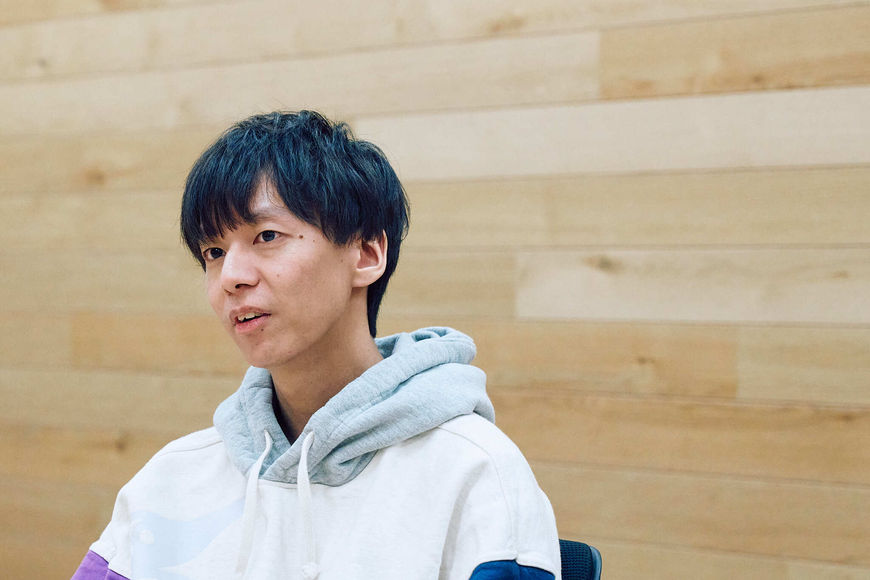
Katsuragawa (PP): It's incredibly empowering to work in where researchers not only understand business problems deeply but also help find solutions within real-world constraints. The best part is debating the optimal solution based on insights from cutting-edge research. And it's deeply rewarding to see the solution we built—one that is sometimes even recognized academically—directly fuel the business growth.
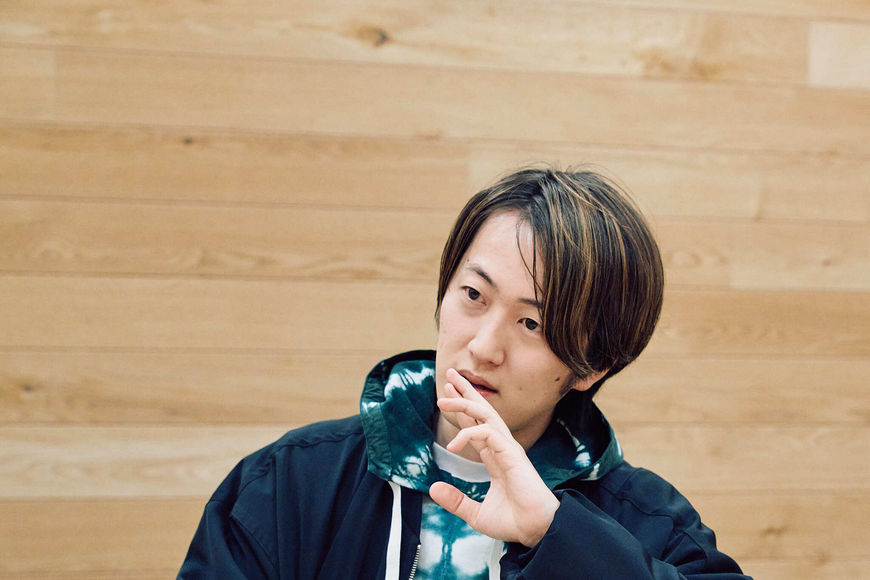
Kaneko (PP): As a data scientist in the field, a major goal was to achieve paper acceptance at top conferences like WSDM's Industry Day, The Web Conference, or KDD*, as proof of the quality of our outcome. AI Lab continuously produces world-class research, and the environment that allows for daily collaboration with them enabled us to elevate our practical work to a level recognized by the research community. Discussions with researchers from Google and Microsoft, and the high praise from the session chair, were very encouraging, and we are proud of our efforts in meeting global standards.
Working with AI Lab, I'm confident we can continue to aim for the world's top conferences. I'm excited to pursue new breakthroughs with others who share that same passion for technological exploration.
*The Web Conference and Knowledge Discovery and Data Mining (KDD) are top international conferences in the data mining field.
――What do you find appealing?
Ariu (AI Lab): I believe AI Lab offers an exceptional research environment by global standards. The company's support is substantial, allowing us to focus on research while also collaborating with business teams to create high-impact applications. It's often difficult to publish work on business applications, so I'm very grateful to Prism Partner for allowing us to share this story. There have been times in the past where real-world applications of bandit algorithms proved difficult, but our culture encourages us to learn from those experiences and try again. For anyone who wants to do more than just business-inspired research—for those who want to make a real, essential contribution to the business—this is the perfect place.
Abe (AI Lab): Having come from another company, I was struck by the deep understanding of AI and machine learning across the entire organization. That culture is why the business divisions are so receptive to implementing research from AI Lab. We get a lot of inquiries from business units wanting to use AI to improve their operations and efficiency. I think this positive attitude toward a research organization being deeply involved in the business is something you'd be hard-pressed to find elsewhere in Japan.
Share this story


Follow us!
Maiko Okada x Yoshimichi Kameda – Pioneering the Sustainable Future of Anime at Studio Kurm

Connecting the legacy of Japanese animation to the future. Driven by this mission, Studio Kurm launched in October 2025. In January 2026, Yoshimichi Kameda joined our team as the Chief Creator, marking the full-scale launch of our new structure. Okada aims to maximize value for creators and establish a sustainable production framework. We explore the outlook of this new anime studio, driven by a powerful partnership geared towards long-term growth.